

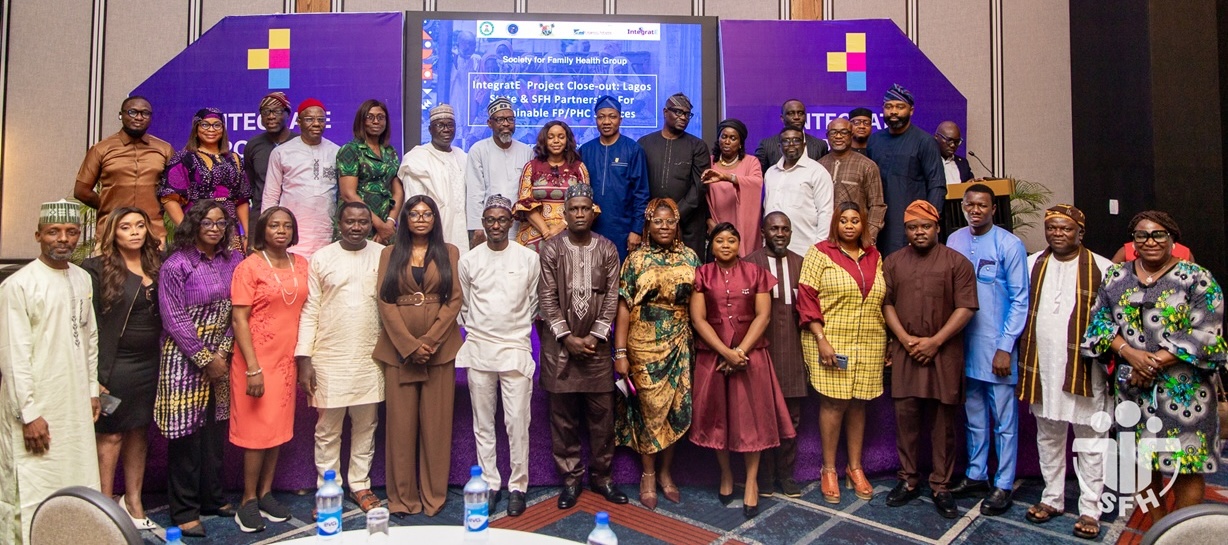

In 2017, the Society for Family Health (SFH), Consortium partners, and the Gates Foundation set out to test a question that would shape nine years of work: could Community Pharmacists and Patent and Proprietary Medicine Vendors, providers long present in Nigerian communities but largely outside the formal health system, be trained, supervised, and regulated well enough to safely deliver family planning and primary healthcare services at scale?
The pilot began in Lagos and Kaduna States, under a three-tier accreditation system implemented with the Pharmacy Council of Nigeria. Four years in, the results were strong enough to justify expansion into nine further states: Enugu, Gombe, Kano, Niger, Nasarawa, Borno, Yobe, Bauchi, and Sokoto, bringing IntegratE to 11 states by the time it wound down that year.
The scale of what followed is now on record. Taken together, IntegratE's direct service and community outreach data show why the project's footprint reached well beyond its trained provider network. Between 2018 and 2026, trained 863 community pharmacists and 4,961 PPMVs nationwide directly delivered family planning services to 1,756,170 women and primary healthcare services to 1,185,849 children under five; nearly 2.94 million people served at the point of care. Layered on top of that, community-based Interpersonal Communication Agents and the AskNivi digital platform reached a further 2.2 million women with family planning information, generating close to one million referrals into the IntegratE provider network. Combined, the project's direct-service and demand-generation channels touched more than 3 million women and children, a reach SFH's Group Director for Donor Funded Portfolio, Pharm. Emeka Okafor, called proof that
"when you train the provider closest to the community, the impact doesn't stay in a facility; it moves through the whole household."
He pointed to a deliberate design choice behind that durability: rather than SFH training providers directly, the project worked through the Pharmacy Council of Nigeria to accredit Schools of Health Technology, which then cascaded the training onward. Even when the project has ended, he said, these schools will be able to take this training forward. SFH, he added, is still here to provide technical assistance to state governments looking to scale the model on their own.
Rodio Diallo, Deputy Director of Family Health, Gates Foundation, said the doubts were answered in the data itself. Comparing the quality of care delivered by trained CPs and PPMVs against public primary health facilities, she said, "They had similar quality of care... they were equally good." That evidence, she said, was decisive enough to move policymakers: CPs and PPMVs are now written into Nigeria's task-shifting, task-sharing framework. "There is no going back. It's right there in the policy."
Dr. Samuel Oyeniyi, Director and Head of the Reproductive Health Division at the Federal Ministry of Health and Social Welfare, said the IntegratE project has demonstrated the value of integrating community pharmacies and PPMVs into family planning and primary healthcare delivery. He stressed the need for sustained public-private sector collaboration to improve health outcomes.
The Pharmacy Council of Nigeria's Registrar, Pharm. Ibrahim Babashehu Ahmed, called the regulatory shift the project's quieter legacy. Before IntegratE, he said, PCN had limited visibility into a workforce that had largely operated outside formal channels; the project "enabled us to now look at the entire stream of the stakeholders" and build the tiered accreditation system that will carry quality standards forward." He framed the stakes in plain terms: because so many Nigerians live far from public facilities, the proximity of PPMVs and community pharmacies makes them serve as a drive to attain universal health coverage.
Delivering the welcome address on behalf of Dr. Dayo Lajide, the Permanent Secretary, Lagos State Ministry of Health, and Dr. Ismail Abdus-Salam, Director of Epidemiology, Biosecurity, and Global Health at the Lagos State Ministry of Health, told stakeholders that as the project closes, our responsibility goes beyond celebrating these achievements; the real question is, what happens next? He pressed further, saying that the state would ensure the lessons from IntegratE are not lost when the project ends, but it would institutionalize the approaches that have demonstrated value and strengthen private-sector engagement within Lagos's broader reproductive health strategy, framing it not as a ceremonial close-out, but as an open accounting that sustains the project’s wins.
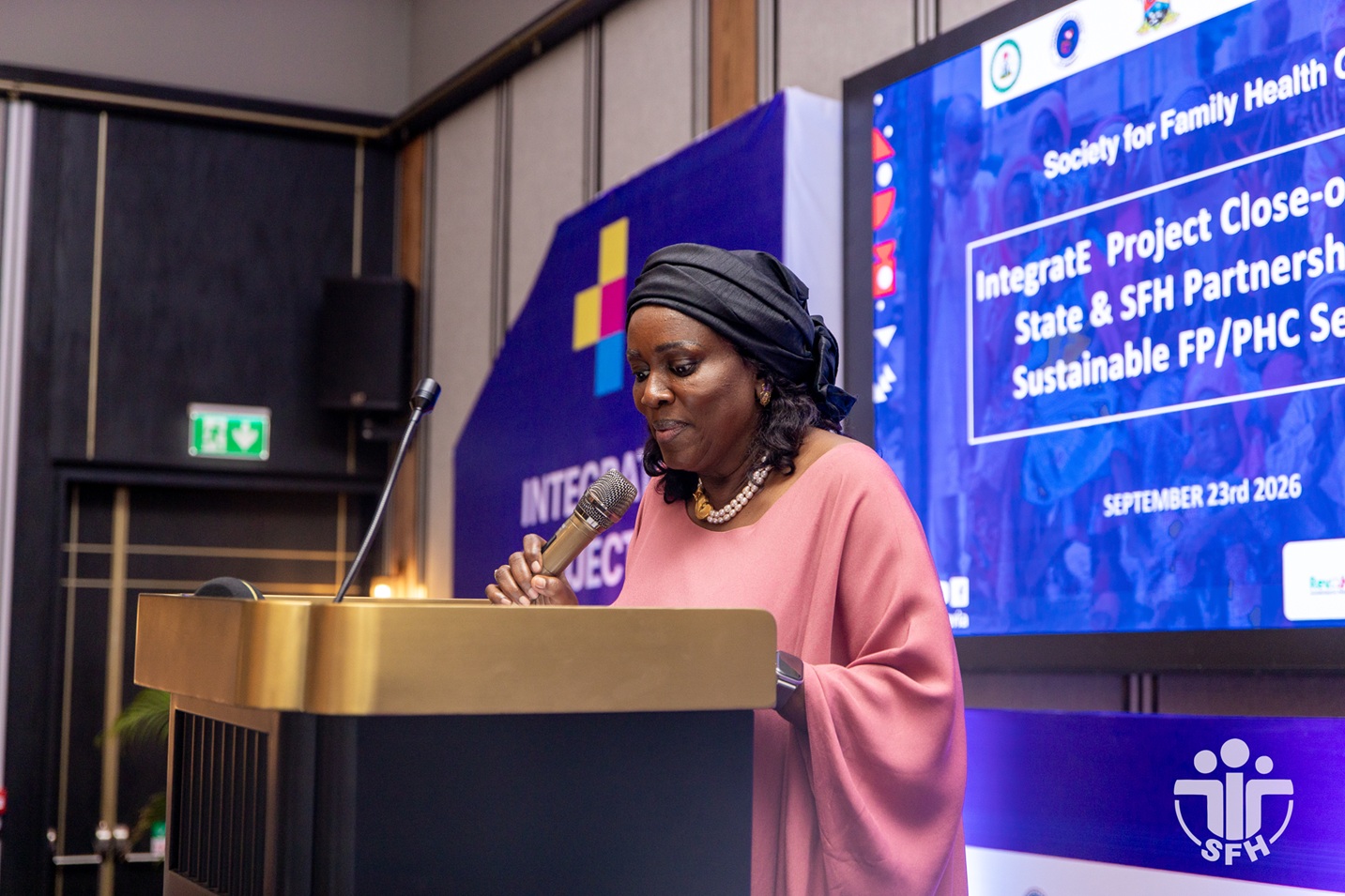
Lagos's Special Adviser to the Governor on Health, Dr. Kemi Ogunyemi, picked up the thread in her opening remarks, insisting that sustainability meant translating lessons into systems, systems into practice, and practice into sustainable results because, as she put it,
"behind every number in a report is a person. Behind every referral is a client waiting for care."
In Lagos State alone, one of the project's two original pilot sites, 904 trained providers, 412 Community Pharmacists and 492 PPMVs reached more than 217,000 women with family planning services and over 146,000 children with primary healthcare care since 2018.
Training has since been cascaded into accredited schools of health technology, supervision is transitioning to government ownership, and project data systems have been formally handed over to the State Ministry of Health, where the project was implemented, the handoff on which IntegratE's lasting impact now rests.